€68,49
VISA, APPLEPAY, GPAY
Hassle-free returns within 30 days
Guaranteed quality
We’re here anytime
From €130
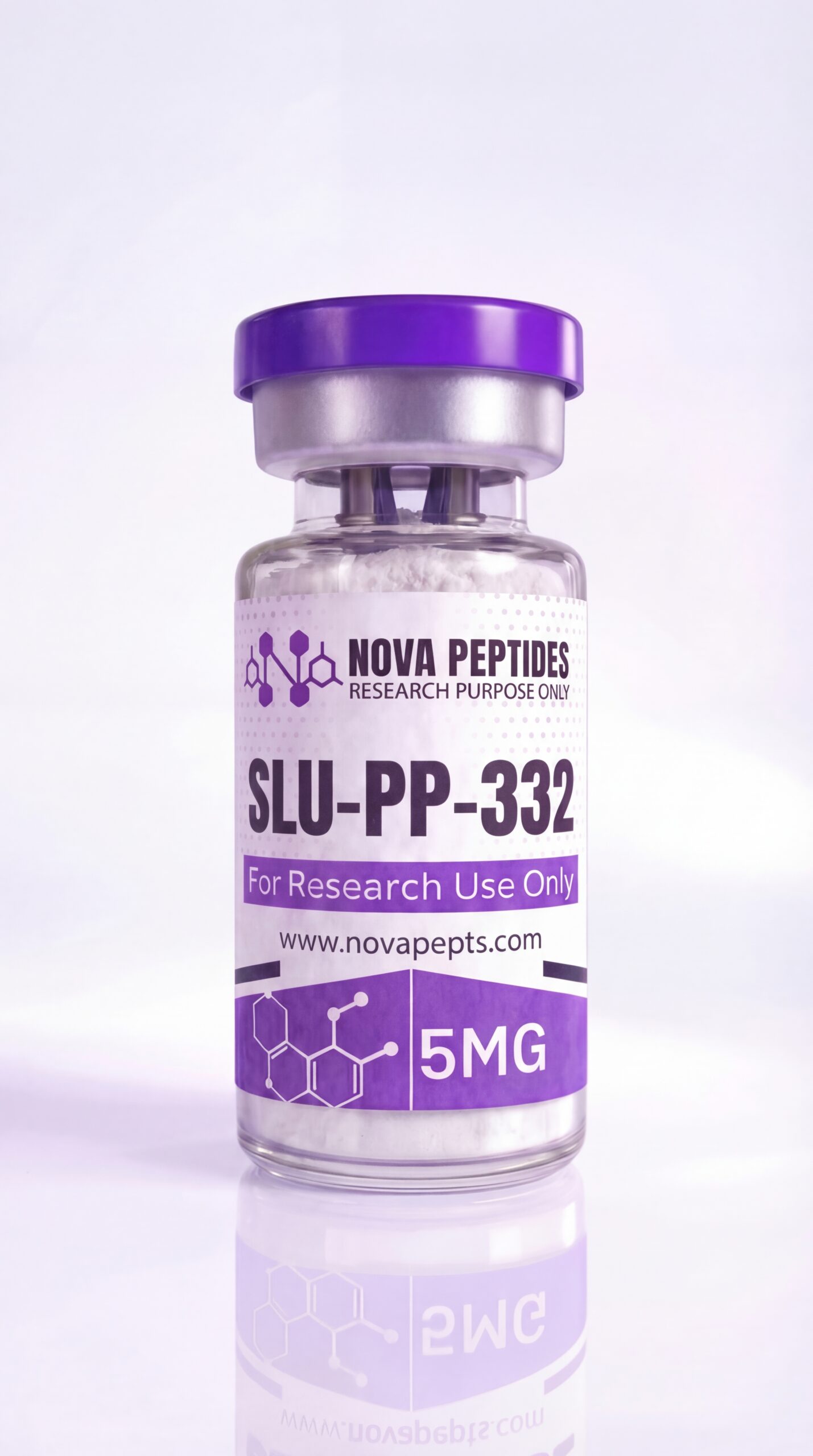
SLU-PP-332 is essentially a shortcut to the energy-efficient state normally triggered by intense endurance exercise.
This small molecule compound activates so-called “orphan” nuclear receptors known as ERRs, without binding to estrogen. Exactly how these receptors work is still not fully understood, but scientists agree on one thing. They act like locks waiting for the right key. SLU-PP-332 fits that role.
Once activated, it nudges the body into one of its most beneficial metabolic states.
Preclinical research points to more efficient fat burning and significantly improved endurance. It also promotes a shift in muscle fibre composition toward fatigue-resistant types, something usually seen only in highly trained athletes.
In simple terms, SLU-PP-332 signals the body to become a more efficient, energy-burning system. No miles. No bike. Same metabolic direction.
That alone makes it exciting. It also places SLU-PP-332 firmly on the radar for researchers studying metabolism, obesity, type 2 diabetes, and the ability to mimic exercise at a cellular level.
The development of SLU-PP-332, often referred to as “exercise in a bottle,” represents a genuine pharmacological breakthrough. It opened doors to research possibilities that simply did not exist before.
CellPeptides is an EU-based research company built around that same standard. We provide pharmacological-grade SLU-PP-332 designed to support serious scientific work.
With us, you get:
Our support team is also available to assist with both order-related questions and research discussions. Whether it is logistics or study design, we are here to help.
All compounds are synthesised in EU-based WHO/GMP and ISO 9001:2015 certified facilities, so you can focus on your research with confidence.
SLU-PP-332 is a synthetic small molecule compound, not a peptide, designed to activate estrogen-related receptors. The name originates from St Louis University, where the compound was developed.
There are three main ERR receptors, and SLU-PP-332 activates all of them. When switched on, these receptors create a metabolic state similar to what the body experiences during endurance exercise.
This leads to several downstream effects. Cells increase mitochondrial production. Muscles shift toward fat as their primary energy source. Muscle fibres adapt to become more fatigue-resistant.
In short, muscles become more efficient and better suited for sustained performance.
While it may sound like a shortcut, the real value lies in its research potential. SLU-PP-332 could play a role in supporting individuals who are unable to exercise due to injury, illness, or age, as well as those dealing with metabolic disorders such as obesity and type 2 diabetes.
SLU-PP-332 is still relatively new, with the first major study published in the early 2020s. Despite that, research has expanded quickly due to the strength of early findings.
Initial studies showed remarkable results. In animal models, subjects were able to run significantly longer and further without prior training.
This was not due to stimulation. Instead, it reflected a complete metabolic shift. Fat became the primary fuel source, while carbohydrate reserves were preserved. Muscle efficiency improved, and mitochondrial production increased.
The overall effect closely resembled that of trained endurance athletes.
These findings make SLU-PP-332 highly relevant in studies focused on metabolic syndrome, sarcopenia, type 2 diabetes, and neuromuscular conditions.
Researchers are exploring whether it can help preserve muscle mass in populations unable to exercise, and whether its impact on fat metabolism and mitochondrial function can support new treatment strategies for metabolic disease.
Beyond metabolism and performance, research is branching into new areas.
SLU-PP-332 has shown potential in cardiovascular studies, particularly in improving mitochondrial efficiency and fatty acid metabolism.
There is also early interest in neurological conditions such as Alzheimer’s and Parkinson’s, as well as broader links to metabolic dysfunction.
Additional exploratory research has looked at applications in viral conditions and even cancer biology. These areas are still early, but they highlight how versatile this compound may be.
SLU-PP-332 is relevant for researchers investigating energy regulation at the cellular level.
Key areas include:
It is also of interest to anyone studying mitochondrial biogenesis and metabolic control.
Dosing varies depending on the model and research objective.
In vivo studies commonly use 5 to 15 mg per kilogram of body weight, typically administered once daily. In vitro research often works within a range of 1 µM to 10 µM.
Some research protocols explore oral administration, although these are less common.
Beginner-level research often starts around 0.3 to 1 mg per day before adjustments are made.
SLU-PP-332 is supplied in lyophilised form and must be reconstituted before use. Bacteriostatic water is typically used for multi-dose studies.
A common method is adding 1 mL of bacteriostatic water to a 5 mg vial. Inject slowly, angle the needle along the vial wall, and gently swirl until fully dissolved. Avoid shaking to maintain compound integrity.
Once reconstituted, store the solution in the fridge and follow proper lab protocols.
For accurate dosing calculations, researchers can use a peptide dosage calculator to match concentration and volume to their study design.