€49,00
VISA, APPLEPAY, GPAY
Hassle-free returns within 30 days
Guaranteed quality
We’re here anytime
From €130
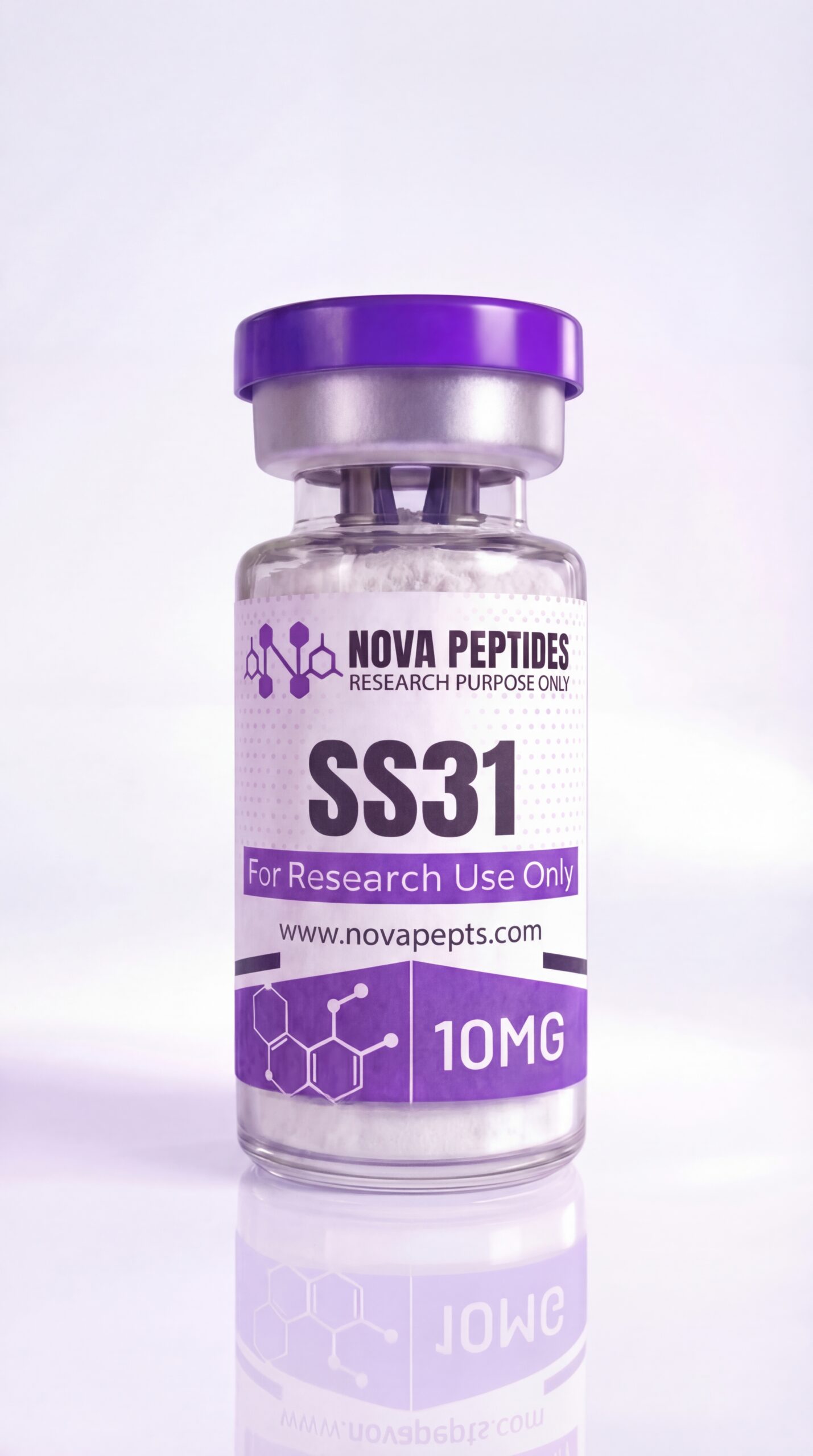
SS-31, also known as Elamipretide, is a synthetic peptide designed to target mitochondria at the cellular level. Originally discovered by Dr Hazel Szeto and Dr Peter Schiller, this peptide is known for its ability to penetrate cells and interact directly with the inner mitochondrial membrane.
SS-31 binds specifically to cardiolipin, a key phospholipid responsible for maintaining mitochondrial structure and energy production. By protecting cardiolipin from oxidative damage, SS-31 helps reduce free radical stress and supports efficient ATP production, which is essential for cellular energy.
Many of the visible signs of aging, such as fatigue, reduced mobility, and declining performance, are linked to deeper mitochondrial dysfunction. As mitochondria become less efficient, energy production drops and oxidative stress increases, leading to gradual cellular decline.
SS-31 is being studied for its ability to support mitochondrial function at its core. By helping stabilise the inner membrane and improve energy output, it offers a targeted approach to cellular health and resilience.
Its research potential spans a wide range of areas, including mitochondrial disorders, cardiovascular health, kidney function, neurodegenerative conditions, and age-related cellular decline. A peptide focused on one of the most fundamental processes in the body, energy at the cellular level.
The mitochondria power the cell. We power your mitochondrial research.
SS-31 is a complex compound, and even the smallest impurity can interfere with its ability to bind to cardiolipin properly. When your research depends on precision, your source matters. CellPeptides is an EU-based scientific company researchers trust when they need pharmaceutical-grade peptides for serious work.
Our SS-31 is synthesised to match the exact D-Arg-Dmt-Lys-Phe sequence pioneered by Dr Szeto. It is:
Need support? Our team is available to help with more than just your order. We can also provide guidance based on your study design.
Quality always comes first. That said, we offer flexible payment options including credit cards, bank transfers, and cryptocurrency.
Pretty elegantly.
Mitochondria produce around 90 percent of the body’s energy in the form of ATP. This process happens along the inner mitochondrial membrane, within structures called cristae. This is also where cardiolipin is found, a key phospholipid responsible for maintaining structure and organising the proteins required for the electron transport chain.
When everything is functioning properly, energy production runs efficiently. Over time, or under stress, this system begins to break down. Reactive oxygen species start oxidising cardiolipin. The electron transport chain becomes disorganised and less efficient. ATP production drops, while oxidative stress continues to rise.
SS-31 is designed to interrupt that cycle.
It can enter cells easily and is naturally drawn to the inner mitochondrial membrane due to its positive charge. Once there, it binds to cardiolipin, protects it from oxidation, restores mitochondrial structure, improves electron transport efficiency, and increases ATP production.
This is not about managing symptoms. SS-31 targets the root cause.
SS-31, also known as Elamipretide, is one of the most exciting peptides currently under investigation. It was discovered by Dr Hazel Szeto in the early 2000s while studying peptides targeting opioid receptors, with entirely unexpected outcomes.
Because SS-31 directly targets the inner mitochondrial membrane, its research potential is extensive. Early studies focused on rare mitochondrial disorders such as Barth syndrome, but interest has expanded far beyond that.
Today, SS-31 is being studied across multiple areas of age-related decline.
Research into cellular aging is still developing, but early findings are promising. SS-31 has been shown in animal models to reverse several signs of aging, including improved physical performance, better muscle function, enhanced cognition, and healthier organ tissue.
Studies have also observed shifts in gene expression linked to longevity, along with reduced inflammation.
Mitochondrial dysfunction is a major factor in neurodegenerative conditions such as Alzheimer’s, Parkinson’s, and ALS. SS-31 has shown early promise in this area.
It is able to cross the blood-brain barrier, reduce oxidative stress, support synaptic function, and protect neurons. Research is still in early stages, but the direction is highly promising.
SS-31 is already being explored in human trials for mitochondrial conditions such as Barth syndrome. Research shows improvements in cardiac output and exercise tolerance.
This is significant, as treatment options for these rare disorders have been extremely limited.
The heart requires a large amount of energy, making it highly dependent on mitochondrial function. SS-31 has demonstrated strong cardioprotective effects, particularly in cases of ischemia-reperfusion injury.
Research has also shown benefits in kidney health, where mitochondrial density is high. SS-31 reduces oxidative stress and inflammation, supporting overall organ function.
Age-related macular degeneration continues to be a major cause of vision loss. Early studies suggest that SS-31 may protect retinal cells from mitochondrial damage.
Research is also ongoing in areas such as glaucoma, with promising early findings.
SS-31 is still in the early stages of research, but its potential is clear. It is relevant for researchers working across a wide range of fields, including:
Mitochondria power every cell. Improving their function opens the door to wide-ranging research possibilities.
Existing research suggests dosing protocols between 1 mg and 5 mg per day, or 0.5 to 5.0 mg per kg depending on the model.
Most studies begin with lower doses to observe response before increasing. Some protocols explore short-term or single-dose applications depending on the research objective.
SS-31 is supplied in lyophilised form and requires reconstitution using bacteriostatic water. A common approach is adding 2 mL to a 10 mg vial.
Once reconstituted, it should be stored between 2 and 8°C and used within 30 to 60 days. Discard if the solution becomes cloudy.
Researchers should always consult existing literature when designing protocols.
What does SS-31 do for the kidneys?
Research suggests SS-31 supports kidney function by improving mitochondrial health. Studies show reduced oxidative stress, lower inflammation, and less cellular damage.
Does SS-31 help with weight loss?
SS-31 is not a weight loss peptide. However, by improving mitochondrial efficiency, it may support overall metabolic health.
What are the side effects of SS-31?
SS-31 has shown a strong safety profile in studies. Mild redness at the injection site is the most commonly reported effect.
What are the effects in Barth syndrome models?
In Tafazzin knockdown models, SS-31 has been shown to restore heart function, improve mitochondrial structure, increase ATP production, and reduce oxidative stress. These findings have played an important role in advancing clinical research.