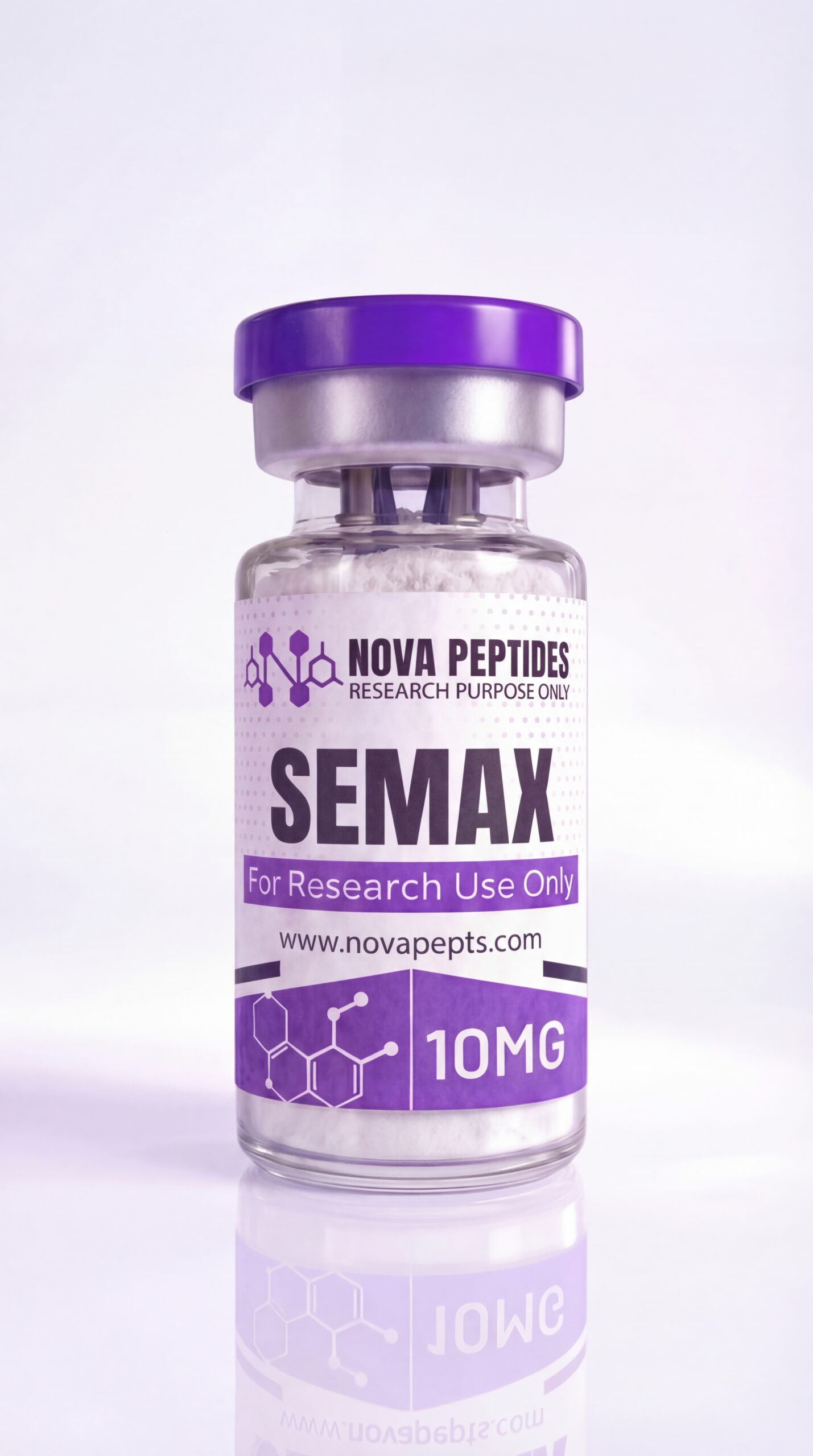
€34,95
VISA, APPLEPAY, GPAY
Hassle-free returns within 30 days
Guaranteed quality
We’re here anytime
From €130
Semax isn’t just another peptide. It is one of the most established and clinically explored neuropeptides in modern research.
Developed by the Russian Academy of Sciences in the 1970s, Semax quickly became a key part of neurological medicine in its home region. It has been used in clinical settings for stroke recovery and brain injury, and even studied for improving cognitive performance in high-pressure environments like space missions.
At its core, Semax is a modified fragment of ACTH (4-10), a hormone involved in the body’s stress response. What makes Semax unique is that it isolates the cognitive and neuroprotective benefits of this hormone without triggering its stress-related effects.
Its primary action is increasing levels of BDNF and Nerve Growth Factor. These are critical proteins that support brain health by promoting neuron survival, strengthening neural connections, and enhancing neuroplasticity.
The result is a compound that supports learning, memory, focus, and resilience under stress. For researchers, this opens the door to studying cognitive optimisation, brain repair, and long-term neurological health.
When working with a compound as powerful as Semax, quality is everything.
CellPeptides provides research-grade Semax designed for precision, consistency, and reliability in scientific studies. Every batch is manufactured in a WHO/GMP and ISO 9001:2015 certified laboratory in the European Union.
With CellPeptides, you get:
99 percent purity, ensuring reliable and reproducible results
Independent third-party lab testing, with full certificates of analysis available
Fast, secure, and discreet global shipping with tracking and insurance
Flexible payment options including credit card, bank transfer, and cryptocurrency
Need support? The CellPeptides team understands peptide science inside out. Whether it is a question about your order or your research design, expert help is always available.
Semax works by enhancing the brain’s natural repair and performance systems.
Originally derived from ACTH research, scientists discovered that certain fragments of this hormone improved memory and cognition without increasing stress hormones. These fragments were stabilised and developed into Semax.
Once introduced, Semax increases the production of BDNF and Nerve Growth Factor. These proteins are essential for forming new neural pathways and protecting existing ones.
But that is only part of the story.
Semax also helps regulate key neurotransmitters like dopamine and serotonin, which play a major role in mood, motivation, and focus. At the same time, it reduces inflammation and protects brain cells from oxidative stress.
Some research also suggests improved cerebral blood flow, which helps deliver oxygen and nutrients more efficiently to brain tissue.
Instead of forcing stimulation, Semax supports the brain in functioning better at a foundational level.
Semax has decades of research behind it, making it one of the most well-documented neuropeptides available today.
One of the earliest and most established uses of Semax is in stroke recovery. Studies show that it can reduce the extent of brain damage and support faster recovery by enhancing neuroplasticity.
By boosting neurotrophic factors and reducing inflammation, Semax helps the brain repair itself more effectively after injury.
Semax has been studied for its ability to improve mental performance in high-pressure situations.
Research suggests it enhances focus, processing speed, and decision-making under stress. This has made it particularly interesting for fields that demand peak cognitive performance, including aviation and space exploration.
Semax also shows promise in research related to mood disorders.
By regulating dopamine and serotonin levels, it may help restore balance in conditions linked to stress, anxiety, and low mood. Its anti-inflammatory effects in the brain further support this potential.
Emerging studies are exploring Semax in conditions like Alzheimer’s and Parkinson’s disease.
Low levels of BDNF and chronic inflammation are common in these disorders. Semax targets both, making it a compelling candidate for future research into slowing cognitive decline.
Semax is a versatile compound with applications across multiple areas of neuroscience and cognitive research.
It may be of interest to researchers working on:
Cognitive enhancement, learning, and memory
Brain injury recovery and stroke rehabilitation
Stress resilience and high-performance environments
Mood disorders such as anxiety and depression
Neurodegenerative diseases and age-related cognitive decline
If your focus is on improving how the brain performs, adapts, and recovers, Semax is a compound worth exploring.
Dosing protocols for Semax vary depending on the study design and model.
Research literature reports a wide range, typically between 0.5 mg and 800 mg, often adjusted based on body weight and study objectives. Most studies begin with lower doses to assess response before increasing gradually.
For multi-dose studies, Semax is supplied in lyophilised form and must be reconstituted using bacteriostatic water.
To prepare:
Slowly inject the solution into the vial, angling the needle toward the wall
Gently swirl until fully dissolved
Avoid shaking to maintain compound stability
Once reconstituted, Semax should be stored in a refrigerator and used within 30 to 60 days. Any solution that appears cloudy should be discarded.
As always, researchers should consult existing literature and design protocols carefully based on their specific objectives.
Is Semax a stimulant?
No. Semax does not stimulate the nervous system like caffeine. It works by enhancing neurotrophic factors and supporting brain function at a deeper level.
What is the safety profile of Semax?
Semax has been used clinically for many years in Russia and is generally considered well tolerated in research settings.
Can Semax affect mood?
Research suggests it may support mood balance by regulating dopamine and serotonin levels.
How quickly does Semax work?
Some cognitive effects may be observed within hours, while neuroprotective benefits typically require longer-term study.